Course Outline of Year 12
Component 1- Controlled Test & Preparation (2 A1 sheets-4sides & sketchbook)
Marked by CIA (30%)
You will receive your exam paper at least three weeks before doing the exam. You must use this time effectively to do all the preparation studies, critical analysis and practical work just as you would have in a longer component.
The controlled test is 15 hours. The exam will be organised over several days for you with breaks. You will take all preparation work into the exam. The final evaluation must be submitted with the final piece at the end of the exam.
Component 2-Coursework (Four A1 sheets-8 sides & sketchbook)
Internal Assessment and external moderation by CIA (20%)
The emphasis of this unit is on self-directed study based on a personal issue or interest. You must demonstrate depth in your research, creative experimentation with skills and processes, knowledge and contextual investigations. Improvement from IGCSE should be apparent. Equal assessment emphasis is placed on the final resolve as the planning and development work. You must include evidence of first hand study, evidence of gallery visits, critique Power-point prints and article reviews.
Assessment Journal
You will be keeping an assessment journal to evaluate your work on a weekly basis. Your work will be marked weekly and you will be given verbal feedback which you will record in your assessment journal.You will be able to improve your work throughout the four assessment objectives until the unit deadline.This journal will be handed in at the end of the course as part of your projects. Record visits, article reviews and hours of free study time spent on work in the journal.
Expectations
Private Study
The Art room can be used for private study. Please do not ask friends to sit with you while you work. You must remember to record the time that you spend in your assessment journal.
Using Art Room Equipment for Private Study
If you are not working in the Art room please do not remove equipment without asking. Borrowed brushes/items must be signed out with the teacher and signed back in.
Deadlines
Deadlines are given to you well in advance, please make sure that you are organised and you meet all the deadlines set. The short term deadlines are to help you keep on top of the workload and understand the assessment criteria. If you feel that you need extra lessons to meet the deadlines please arrange these with your teacher well in advance of the deadline.
Article Reviews
You must complete four article reviews for each project. These can be linked to your project by subject matter, social/cultural context or artist/art movement.
Gallery Visit/E-mail Interview/Workshop/Museum or Crafts visit
In year 13 you are required to include first hand gallery/visit evidence in your sketchbook. Please include sketches/photographs and full evaluations of the experience. You must develop practical ideas related to the visit and make links to your project through this work.
Sketchbooks (A3)
Your sketchbook must include your title as an opening investigative question, Me, myself and I. Include introduction, visual and written mind-maps, critical evaluations, critical studies/enlarged sections by artists, links to Art movements and contextual investigations, critical development ideas, creative process development through appropriate and experimental techniques (combining new materials), project-related first hand observation drawing using varied skills, media and techniques, three dimensional development, composition and colour experiments, development planning drawings, summary final evaluation and bibliography.
Component 2-Personal Investigation (Four A1 sheets & sketchbook) 20% of A level/40% of AS
This is a practical unit with written elements. You will begin the course with a series of workshops based on the project “Me, Myself and I”. These are technical and process based workshops to give you a foundation on which to build your project.
You are expected to then develop the project into a personal investigation into an idea, issue or theme leading to a final piece.
The themes are to be selected from Nostalgia and Memories, Portraiture through history, Skeletal and Human Forms, Identity and Culture, Life events, Personal Objects.
The practical elements should be linked the practice of past or contemporary relevant artists. Written material must include analysis and contextual investigation evidence linking artists study to cultural, historical and contemporary factors.
You must use the help sheets to complete this written work in enough depth. Use specialist vocabulary, organise information clearly and coherently.
You must demonstrate your ability to research, develop ideas, experiment with materials by combining media and experimenting appropriately, write critically and formalise your ideas. You must show how you have been inspired by historical, cultural, social, political and social influences. You will develop aesthetic understanding throughout the course.
AO4 – Working from observation: The list below is the minimum requirement. If you have completed any extra sketches and paintings, taken photographs or sketched when visiting places GREAT! You will have obviously extended your learning and should therefore gain a higher grade.Tick off when completed.
WEEK 1 and 2 |
A6 sketchbook full of ideas |
Cover sketchbook to make it personal. Include your name |
Visual Brainstorm |
A3 pencil portrait |
Colour theory (2 pages) |
Skin tones, practising colour mixing ( 1 page) |
A2 blind painting |
A3 painting on photocopy (skin tone) |
A3 painting on photocopy (complementary colours) |
Distorted pencil portrait |
WEEK 3 |
Mono-print using photocopy |
5 Blind portraits in sketchbook |
Poly prints on different backgrounds. Write up process |
Collograph. Write up process |
WEEK 4 |
Powerpoint presentation (made into short film) |
Print out presentation and mount either in book/ on paper |
Put presentation onto CD or disk for moderation Work on top of at least one image using mixed media, tissue paper, |
Review of article from art magazine |
WEEK 5 |
Sculpture made from wire |
Photo of wire sculpture in sketchbook and explanation of process |
Card sculpture in the style of Gabo |
Critical Study of Naum Gabo’s head |
Plaster cast of section of face |
Photo of plaster cast and explanation |
Deadline date for all observation for Me, Myself and I work to be completed by 14th October. We will then start Critical Studies based on the following choice of concepts:
This list of artists will help you identify with relevant artists:
Nostalgia, Dreams and Memories | Tracey Emin, Salvador Dali, Magritte, Chagall, Joeph Beuys, Paul Nash, Yinka Shonibare, |
Skeletal and Human Forms | Leonardo Da Vinci, Anthony Gormley, Christine Borland, Giacometti, Terry Winters, Henry Moore, Barbara Hepworth, Elisabeth Frink, Richard Deacon, Jenny Saville, William de Kooning, |
Identity, Icons and Culture | Pop Art, Rosenquist, Peter Blake, Julian Opie, Frida Kahlo, Andy Warhol, Cindy Sherman, Mona Hatoum, Sonia Boyce, Chris Ofili, |
Life Events, Celebrations, Journeys and Places | Rauscheberg, Kathy Prendergast, Goldsworthy, Richard Long, Karl Weschke, Jeremy Dellar, Henri Rousseau, Bartholdi, Dexter Dalwood, |
Personal Objects | Vanitas, Tracey Emin, Grayson Perry, |
Portraiture through History, Expressions through Portraiture. | National Portrait Gallery, Henri Matisse, Picasso, Francis Bacon, Frazal Sheikh, Hogarth, Rembrandt, Sir Joshua Reynolds, Gwen & Augustus John, David Hockney. |
You are encouraged to do your own research and discover your own artists.
A06&7 – Critical Studies
3 Complete critical studies for each you should have:
Copy of an artist’s artwork
1 written critical study (double page)
Contextual study (double page)
And support studies/work
A03 – Development
3 development concepts
written evaluations and analysis
Support studies
Experimenting in a range of materials and process for each
You should have at least 2 double pages for each concept
A04 – Observational Drawing
Support sketches relevant to your final piece intentions
Show different drawings styles and using different media and techniques
You should have at least 4 double pages of observational drawing
A04 – Final Resolve
This will be done in timed lessons – in the style of a mock exam in preparation for your exam.
In your 15 hours you will need to create and develop a final idea that shows a variety of solutions at high quality. This is not one refined final piece.
Assessment Objective involved | Objective explained and work to be done | Deadline | Weeks | |
AO4&5 | Analytical Skills | Observational drawings/paintings/3D explorations. Recognition and articulation of skin tones, form, surface, contours, skin textures: based on analysis from observing the face. | August -Oct 7th | 6 |
AO1&2 | Personal Qualities
| Independent concept/idea, vitality, scope, front cover, introduction of concept, visual & written brainstorms, experimental thinking, collection of imagery) | Oct 10th-Oct 24th | 3 |
AO6&7 | Knowledge and Critical Understanding
| Critical and contextual investigations that show art movement links/social/cultural/political understanding. Critiques presented by Power-point. Use of specialist vocabulary, ability to articulate and personal and aesthetic views. All critical and contextual evaluations will be written, critical practical studies and close-up sections. 1st developments including your own version of each artist. | Nov 1st-Nov 11th | 6 |
AO3 | Manipulative, Artistic and Analytical Skills
| Varied & combined media, materials and development through processes, experimentation, Working towards a final idea. | Nov 14th-Nov 28th | 5 |
AO5 | Aesthetic Qualities
| Composition, textural, special, tone, structure, form and colour decisions, articulation and annotations of intentions, Organising and communicating quality of finish. Final Piece. | Nov 28th-Jan 3rd | 6 |
Component Deadline is 9th January 2012
Please ensure that you meet all the deadlines, we are here to help so if you have a problem with workload or keeping up talk to your teacher.
The work you complete on the course will be marked and moderated, displayed in a school exhibition and will be used for your portfolio for interviews.
Component 1- Controlled Test & Preparation (Four A1 sheets & sketchbook 30% of A2 and 60% of AS)
Assessment Objective involved | Objective explained and work to be done | Deadline | Weeks | |
AO1&2 | Personal Qualities
| Independent concept/idea, vitality, scope, front cover, introduction, visual & written brainstorms, experimental thinking, collection of imagery | Jan 16th –Jan 23rd |
|
AO6&7 | Knowledge and Critical Understanding
| Critical and contextual investigations that show art movement links/social/cultural/political understanding. Use of specialist vocabulary, ability to articulate and personal and aesthetic views. All critical and contextual evaluations will be written, critical practical studies and close-up sections. 1st developments including your own version of each artist. | Jan 23rd –Feb 6th |
|
AO3&4 | Manipulative, Artistic and Analytical Skills
| Varied & combined media, materials and development through processes, experimentation, observational drawings/paintings/3D explorations. Working towards a final idea. Composition, textural, special, tone, structure, form and colour decisions, articulation and annotations of intentions, | Feb 6th – March 2nd |
|
AO5 | Aesthetic Qualities
| Organising and communicating quality of finish. Final Pieces/Series of Resolutions | See exam timetable (15 hours) |
|
All work to be clearly named and labelled, presented with signed paperwork and bibliography
Your exam date is ____________________(fill this as soon as the exams office informs you)
Your deadline for mounting up and handing in the exam project date is 30th March 2012
Critical Analysis Help Sheet
Your Critical Studies should be written in essay format. You should write about the following points
Content - Describe the piece of artwork?
What is it off? Is it a sculpture, installation, painting etc? Landscape/portrait/still-life?
How old is the art? Date?
Is the artwork from imagination or observation?
Is the artwork realistic or abstract?
Has the content been distorted or extended in anyway?
Is the content of the piece of work telling a story or making any statements about religion culture or society? How do you know?
Is it representing anything i.e. religion, death, love etc? Are these statements obvious or are they hidden?
Are there any symbols used in the work to represent something i.e. wealth, religion, animal characters, Greek mythology etc.
What do you think about the content of the artwork - explain?
Form – How has the artwork been designed and composed?
How has the artwork been arranged? Size and proportions?
What colours have been used, how and where?
Are the colours harmonious or contrasting? Are they subtle of bright?
Does anyone colour have more impact than any other? Are the brush strokes transparent or opaque?
What shapes/patterns, if any, have been used? If so, are they geometric? If so, do the shapes/patterns connect to each other?
What is the texture of the artwork i.e. is it smooth or rough?
What do you think about the design, colours, shapes and patterns of the artwork - explain?
Process – How has the artwork been made?
How has the artwork been made and what is it made off i.e. wood, metal, oil on canvas etc
Describe any techniques the artist has used.
Do you think the artist had to do preparatory work before doing the final artwork? If so what?
Your Opinion
Why did you choose this piece of work?
What do you think the mood of the painting is and explain why you think this and how the artwork communicates this?
What will you take from this piece of artwork or the artists work through into your own work?
What did you learn through the research that you did on the artist and how did this inform/change your opinion.
Contextual Studies – Informative Content & Visual Appearance
You must complete two double pages of Contextual Studies for each artist in your sketchbooks.
One artist contextual study must include the following:-
- Background painted/drawn/collaged yourself in the artists colours and style. Take a section of the main image and enlarge it as a background.
- Images printed including closer details (drawn/painted into yourself) of the main piece of work that you are looking at.
- Other images by the same artist showing the same style of working as your chosen critical study.
- Other images showing the same artist working in a different style or media.
- Why was it made/created? Was it a commission? (If so, by who/who paid for it?)
- Tear off some of the images and finish the second half yourself.
- Information and images of other artists of the same time/era, art movement.
- Detailed information on the Art movement of the time
- Technological innovations (photography/oil paints/transport communications) of the time.
- Religious influences (if any).
- Culture and society of the time and place in which it was created.
- Where is it now exhibited? Give some detailed information on the gallery, who chose it for the exhibition and why is it exhibited in this way?

X3 (one double page for each artist)
You should also have a Critical Study (practical copy) for each artist and a Critical Analysis for each artist using the help-sheet pages available in your blue booklets.
Final Evaluation Help Sheet
An evaluation must be completed
for each Coursework Unit and also the Controlled Test. This is worth doing
because it emphasizes how well “informed” your ideas are to the examiner.
You need to make your evaluation as detailed
as possible, be over-explanatory leaving the examiner to read your reflections
and thoughts about your project:
Describe your theme or starting point
Explain how you researched your ideas e.g. drawing, collage, photography, visits, collecting resources.
Analyse your work, describing what has been successful and where you may have improved your work. Discuss the media and techniques that you have used throughout and how these relate to your intentions and how these processes furthered your ideas. Discuss whether the materials used were appropriate to your theme, how unusual combinations of materials worked.
Describe alternative solutions that you considered and the reason for your final choice of direction. Make all the visual connections very explicit.
Note all the artist(s) or designer(s) that you have studied for critical reference and explain how this research has influenced your own ideas and the use of media techniques. Explain exactly how the contextual studies gave you additional ideas and improved your understanding of the Art movements involved. Explain how the contexts that you learned about gave you understanding of your chosen artists intentions.
In your conclusion discuss aspects which you have enjoyed, what you have learned, describe what improvements or further developments you could make if given more time.
It is vital that all personal opinions are backed up by evidence or reasoned judgements.
Specialist art vocabulary should always be used.
Make sure that your project has thorough annotations throughout.
Your evaluation should be at least 450 words.The evaluation should be written in essay form, explain all the practical work and summarize the project.
CRITICAL ANALYSIS ADVICE AND GUIDANCE INSTRUCTIONS
Writing a visual analysis of a piece of artwork can be a difficult task. A visual analysis is a vivid description and discussion of your own observations of a work of art, including its appearance, medium and underlying concepts. Read on to learn how to write a visual analysis.
1. Step 1
If possible look at the work without any distractions such as music, television, or talking people and try to focus completely on your sense of vision. Note down the main things you notice about the painting's appearance, such as its medium (oil on canvas, marble sculpture or ink drawing on paper), colours and subject. Look at the areas covered on the help sheet.
2. Step 2
Now it is time to dig deeper. Think about the artist and his theoretical and visual interests. Write down everything you know, particularly in relation to any artistic movements in which he/she may have participated. If you do not know anything about the artist, make sure to do some research before writing your analysis. Find out about their culture, society, beliefs and other art of their time.
3. Step 3
Look at the artwork again, now thinking about the art in the context of the artist's background. Are there any visual characteristics to the work that identify the artist's style?
4. Step 4
Use your notes to write your thoughts from steps 1-3 to write out the start of your visual analysis. Be sure to include the artist, title and date at the beginning. Typically, visual analysis is quite formal in so make sure you use descriptive specialist language to really bring the piece to life. When writing a visual analysis, the thesaurus/glossary is your best friend.
5. Step 5
Proof-read you analysis to check for any spelling mistakes and check that you have spelled the artists’ names correctly.
If you are assigned to write about a painting remember that it is not necessary to write a highly technical analysis. You only need to look carefully at the painting then analyze and classify what you see. If you have never written about a painting before, it is helpful for you to consider the points on the helpsheet when studying the painting.
If the work you are studying is an abstraction you will need to focus more on:
Paint handling
Direction and flow
Colour use
Mood
Research the artist and discover the relevant Art movement and/or contextual information:-
(sample below)
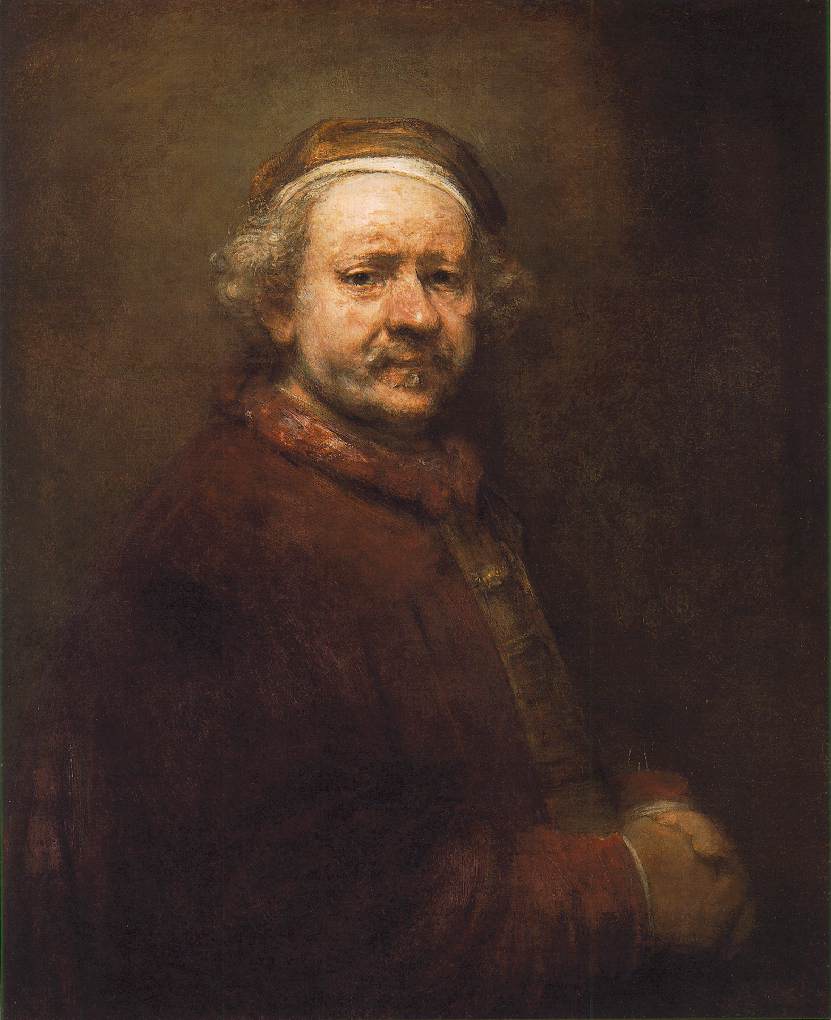
Rembrandt's Self Portrait in the National Gallery ( Introduction: This is a very brief essay, and as a result, the introduction is concise) Rembrandt's "Self Portrait" in the East Wing of the National Gallery is a startling painting. Rembrandt placed his face in the upper two thirds of the canvas which is 33¼" by 26". It was painted in 1656. (Analysis::Now you can begin to explain why you find this painting to be startling.) Artists usually paint themselves well dressed, happy, sitting at an easel, working. In this painting, however, Rembrandt looks inexpressibly sad, timeworn, and defeated. While everything else is in shadow, the face is illuminated as if it attracts all the light. His face is softening with age; his unruly hair is tinged with gray. His eyes look out, capturing and pinning me the moment I enter the gallery. I feel as if I had disturbed him while he was painting. (What about this painting has given the impression that Rembrandt looks sad or defeated? Is it the colors the artist used? Is it the pose, or the facial expression? You should describe some specific parts of the painting in order to support your analysis. You may also wish to compare this work to other paintings by the same artist.) His coat looks dull, nondescript. In contrast to other self-portraits where Rembrandt painted himself in finery, in this painting he looks like he is wearing an old coat, and an old hat. The color and quality of his clothing adds to the sombre mood of the painting. His hands are not visible. In fact, no skin other than his face is visible. Perhaps his hands would have taken some of the light away from his face, and he wanted to
| draw the audience's attention immediately to his face. It is as though he meant to emphasize the importance of his facial expression and the lines in his face, and de-emphasize the importance of everything else. It looks like he's just turned around to see who entered the room-- and he'd rather not have been interrupted from his thoughts. The only other form that captures any light is the curved form in the lower portion of the painting. It is possible that shape is his palette. (Drawing Conclusions:You should attempt to explain why you think the artist painted himself in this way.) Rembrandt made a self-portrait almost every year of his life, beginning about age twenty. The early portraits depict a smiling, self-confident, prosperous Rembrandt. These were probably intended to be advertisements of his skill to attract commissions. Clearly this painting was not designed to attract commissions. Perhaps this painting's intent was to capture a more honest, uncensored truth of the artist's life. He could have made himself look however he wanted, but he chose this somber pose. (Conclusion:Reiterate your thesis and the important points you made, and leave the reader with something more to think about.) Though we do not absolutely know why he depicted himself in this dark way, we must assume that Rembrandt was certainly trying to both evoke and express a feeling of uncomfortable defeat. Perhaps Rembrandt has painted the reality of his life-- a dimly lit, cold room; worn, dark clothes; a pensive, tired expression-- and his current emotional state without hiding behind flashy clothes and bright colours. |
Glossary of Terms.
After-image | Weak image of the complementary colour created by the brain as a reaction to prolonged looking at a colour. (After looking at red, the after-image is green). |
Alternating rhythm | Repeating motifs but changing the position, content or spaces between them. |
Analogous colour | Colours that are beside each other on the colour wheel. |
Art criticism | The process and result of critical thinking about art. It usually involves the description, analysis and interpretation of art, as well as some kind of judgement. |
Assemblage | Sculpture consisting of many objects and materials that have been put together. |
Asymmetrical balance | Informal balance in which unlike objects have equal visual weight. |
Background | Part of the picture plane that seems to be farthest from the viewer. |
Balance | Principle of design that deals with arranging the visual elements in a work of art for harmony of design and proportion. |
Bas-relief | Sculpture in which part of the surface projects from a flat plane. |
Chiaroscuro | Using contrast of light and dark to create the illusion of three-dimensional form on a two-dimensional surface. |
Clustering | In design, creating a focal point by grouping different objects or shapes together. |
Colour wheel | A tool for organizing colour. |
Complementary colour | Colours that are directly opposite each other on the colour wheel (for example, blue and orange). |
Composition | Arrangements of elements in a work of art. |
Continuation (continuity) | In design, arranging shapes so that the line or edge of one shape leads into another (technique for creating unity). |
Contour lines | Contour lines define edges, ridges or the outline of a shape or form. |
Contrast | A large difference between two things. It is a technique often used to create a focal point. |
Crafts | Arts works that are both decorative and functional. (Weaving, fabric design, jewellery-making and pottery). |
Crosshatch | Technique for shading using two or more crossed sets of parallel lines. |
Culture | Behaviours, ideas, skills and customs of a group of people. |
Distortion | Changing an object's usual shape to communicate ideas and feelings. |
Dominant element | Element in a work of art that is noticed first (elements noticed later are subordinate). |
Emphasis | Principle of design that stresses one element or area to attract the viewer's attention first. |
Exaggeration | Increasing or enlarging an object or figure to communicate ideas or feelings. |
Flowing rhythm | Visual rhythm that is created by repeating wavy lines. |
Focal point | Area of an art work that attracts the viewer's attention first. Contrast, location, isolation, convergence and the unusual are used to create focal points. |
Foreground | Part of a picture which appears closest to the viewer and often is at the bottom of the picture. |
Foreshortening | A form of perspective where the nearest parts of an object or form are enlarged so that the rest of the form appears to go back in space. |
Gesture drawing | A drawing done quickly to capture a movement. |
Hue | Another word for colour (colour has three properties: hue, value and intensity). |
Intensity | Brightness or dullness of a colour. Intensity can be reduced by adding the colour's complement. |
Linear perspective | Technique of creating the illusion of depth on a flat surface. The lines of buildings and other objects converge to a vanishing point on a horizon line (viewer's eye level). |
Logo | A visual symbol that identifies a business, club, individual or group. |
Medium | Any material and technique used to produce a work of art (paint, glass, clay, fibre, etc.). It may also refer to the liquid with which powdered pigments are mixed to make paint. |
Middleground | Area in a picture between the foreground and the background. |
Mixed media | Any art work which uses more than one medium. |
Monochromatic colour | Colour scheme which uses one hue and all its tints and shades for a unifying effect. |
Motif | Repeated unit to create visual rhythm. |
Negative space | Space around an object or form. |
Neutral colours | Black, white and grey. |
Opaque | Quality of a material that does not let any light pass through. |
Organic form | Shapes or forms that are free-flowing and non-geometric. |
Path of movement | The path along which the viewer's eye moves from one part of an art work to another. |
Pattern | Lines, colours or shapes repeated in a planned way. |
Perspective | Method used to create the illusion of space on a two-dimensional surface. Can be created by overlapping, placement, detail, colour, converging lines and size variations. |
Picture plane | The surface of a drawing or painting. |
Point of view | Angle from which the viewer sees the object. |
Positive space | Shapes or forms on a two-dimensional surface. |
Principles of design | Guidelines that artists use in composing designs and controlling how viewers are likely to react to the image. Balance, contrast, proportion, movement, emphasis, variety, unity and repetition are examples of the principles of design. |
Proportion | Principle of design concerned with the relationship of one object to another with respect to size, amount, number and degree. |
Radial balance | Kind of balance where the elements branch out from a central point. |
Random rhythm | Visual rhythm in which a motif is repeated in no apparent order. |
Regular rhythm | Visual rhythm created through repeating the same motif with the same distance between placements. |
Repetition | Technique for creating unity and rhythm in which a single element or motif is used over and over again. |
Reproduction | Copy of a work of art. |
Rhythm | Principle of design that repeats elements to create the illusion of movement. There are five kinds of rhythm: random, regular, alternating, progressive and flowing. |
Scale | The proportion between two sets of dimensions. |
Shade | Dark value of a colour made by adding black. |
Space | Space can be the area around, within or between images or elements. Space can be created on a two-dimensional surface by using such techniques as overlapping, object size, placement, colour intensity and value, detail and diagonal lines. |
Split complementary | A colour scheme based on one hue and the hues on either side of its complement on the colour wheel. |
Style | Style is the artist's ways of presenting things. Use of materials, methods of working, design qualities, choice of subject matter, etc. reflect the style of the individual, culture or time period. |
Subject | A topic or idea represented in an art work. |
Subordinate element | Element in an art work noticed after the dominant element. |
Subtractive method | Sculpture that is made by cutting, carving or otherwise removing material. |
Symbol | Visual image that represents something else. |
Symmetrical balance | Formal balance where two sides of a design are identical. |
Tint | Light value of a colour made by adding white. |
Translucent | Quality of material which allows diffused light to pass through it. |
Transparent | Quality of a material which allows light to pass through it. |
Trompe-l'oeil | Means "fool the eye". Style of painting where the artist creates the illusion of three-dimensional objects. |
Unity | Principle of design that gives the feeling that all parts are working together. |
Value | The lightness or darkness of a colour. |
Vanishing point | In perspective drawing, a point or points on the horizon where receding parallel lines seem to meet. |
Variety | Principle of design concerned with difference or contrasts. |
Visual weight | The interest or attraction that certain elements in an art work have upon the viewer. |
Use this page to record all the free study periods that you use for Art. This will ensure that you know that you are doing enough work.
DATE WEEK ENDING | HOURS COMPLETED IN FREE STUDY |
| DATE WEEK ENDING | HOURS COMPLETED IN FREE STUDY |
|
|
|
|
|
|
|
|
|
|
|
|
|
|
|
|
|
|
|
|
|
|
|
|
|
|
|
|
|
|
|
|
|
|
|
|
|
|
|
|
|
|
|
|
|
|
|
|
|
|
|
|
|
|
|
|
|
|
|
|
|
|
|
|
|
|
|
|
|
|
|
|
|
|
|
|
|
|
|
|
|
|
|
|
|
|
|
|
|
|
Bibliography
Please update this as you work through the course
| Assignment | Book Title/Website address |
|
|
|
|
|
|
|
|
|
|
|
|
|
|
|
|
|
|
|
|
|
|
|
|
|
|
|
|
|
|
|
|
|
|
|
|
|
|
|
|
|
|
|
|
|
|
|
|
|
|
|
